GradeSmith
AI-powered exam evaluation

AI that grades the way your examiners do

GradeSmith reads handwritten answer scripts — text, equations, diagrams, and code — at 99% OCR accuracy and scores every answer against the rubric your examiners approve. No special sheets, no barcodes, no change to how exams are set, conducted, or collected.

90%Less evaluation load 15 million+Pages evaluated 6+Institutions live
answer-sheet-view
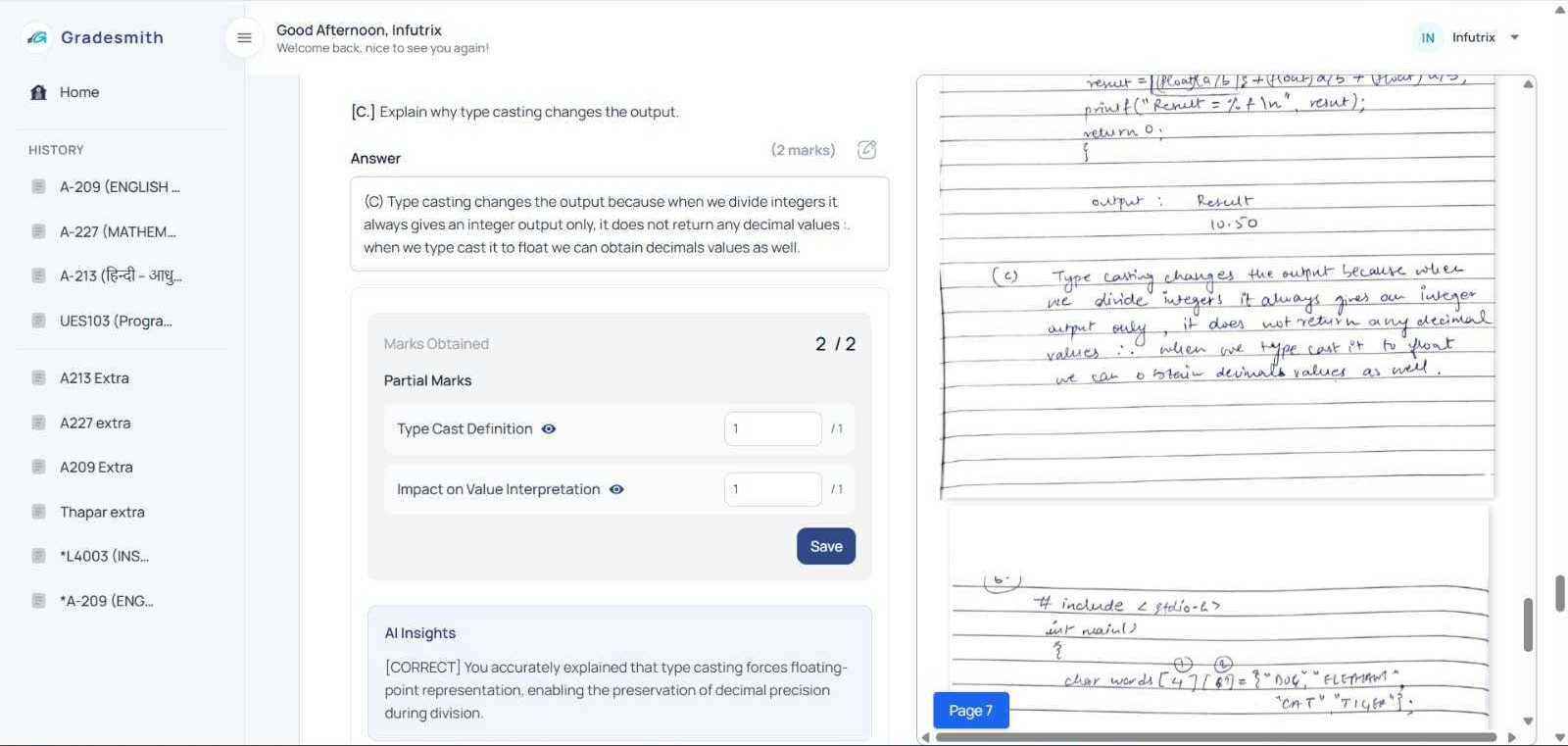
A GradeSmith evaluation screen: rubric-level marks beside the scanned answer script
Live evaluation screen · rubric marks beside the original script
Live in production across universities, engineering institutes and school networks
Thapar Institute of Engineering & Technology Kurukshetra University Panipat Institute of Engineering & Technology Chaudhary Charan Singh University, Meerut Doon Public School Rysen Group of Schools
Who it's for

Made for the way your institution already works.

Select one to see how GradeSmith fits.

GradeSmith for {{ personaName }} {{ persona.title }} {{ persona.body }}
{{ pp }}
What a session looks like {{ row.label }}{{ row.value }}
Evaluation as it runs today

Tens of thousands of scripts. One exhausted process.

Assessment is where the calendar breaks. Marking pools, evaluator mobilisation, hand-written marks, re-totalling, paper trails — weeks of logistics before a single result reaches a learner. Teachers and examiners lose 6–8 hours of every week to marking alone.

01Paper settingPaper-setters draft; a moderation panel reviews.
02Exam conductInvigilation; scripts collected and sealed.
03Manual evaluationEvaluators mark in batches; marks hand-written.
04Re-totalling & entryCheckers verify totals; operators key in marks.
05Result & grievanceResults published; rechecking handled offline.
4–8Weeksfor a single result cycle, from exam to publication.
30–40%Higher errorsin later scripts, as evaluator fatigue sets in.
15–20%Of re-evaluationstrace to clerical slips — not academic judgment.
The turn

What if evaluation kept pace with the rest of your calendar?

Without changing a single thing about how your exams are set, conducted, or collected — and without taking the final mark out of an examiner's hands.

Weeks of markingOne reviewed pass
Marking by hand vs GradeSmith

Every script marked to the same standard — the first booklet and the five-hundredth.

Marking by hand 4–8 weeks Marking pools and evaluator mobilisation. Standards drifting between the first pile and the last. Re-totalling slips, transcription errors, and a backlog that outlives the term — while learners wait for results that arrive too late to act on.
With GradeSmith One pass Scan, rubric, evaluate, publish. Handwriting read at 99% OCR accuracy, rough work identified, every answer scored against your criteria with its reasoning attached — and the whole batch comes back while the session is still current.
Where GradeSmith plugs in

GradeSmith doesn't replace your process. It plugs in at exactly four points.

Everything before answer-script collection stays exactly as it is today.

01Paper settingUnchanged
02Exam conductUnchanged
03Scan & uploadPost-exam collectionGradeSmith
04Rubric finalizationExaminers in controlGradeSmith
05AI evaluationApplies the approved rubricGradeSmith
06Results & insightsMarks, insights, feedbackGradeSmith
1 · Scan & uploadAny standard scanner or phone camera. Existing sheets, exactly as they are — no special paper, no barcodes.
2 · Faculty approve the rubricEvery rubric, weightage, and model answer is finalized by your department before evaluation begins.
3 · AI evaluates every scriptYour rubric, applied uniformly — descriptive answers, MCQs, diagrams, equations, and code.
4 · Results & audit trailMarks publish with a per-question audit trail and cohort analytics, and per-student feedback goes back to the learner.
One script, all the way through Scan · Rubric · Evaluate · Publish
01Scan & upload 02Rubric approved 03Evaluated per criterion 04Marks published
Q1 · Definition2.0 / 2 Q2 · Derivation4.5 / 5 Q3 · Diagram3.0 / 3 Total9.5 / 10

The AI never grades against anything your examiners haven't signed off on — and they keep final authority over every mark.

Inside the platform

The evaluator sees the script and the score, side by side.

Screens from a live deployment: the transcribed answer, marks at rubric level, the AI's reasoning, and the original page it came from.

gradesmith · answer-sheet-view
GradeSmith evaluation screen
Per-question marks against the approved rubric Every sub-criterion carries its own mark box. The evaluator sees the transcribed answer beside the original script page and can override any score before results publish.
Six problems · one platform

Every institution names the same six. Here is what changes.

Result cycles that take weeksTodayManual evaluation, scrutiny, and data entry stretch a cycle to 4–8 weeks.SolvedA whole batch evaluated in one pass, so results move at the speed of your calendar instead of examiner availability.
Inconsistent markingTodayThe same answer scores differently across evaluators — or across a single long day.SolvedOne identical rubric applied to every script. No fatigue, mood, or interpretation drift.
Evaluator burnoutTodayError rates climb 30–40% in later scripts graded under deadline pressure.SolvedGradeSmith handles the first pass, cutting roughly 80% of the marking load off faculty.
Handwriting, diagrams & codeTodayScripts mix varied handwriting with diagrams, equations, and code — slow to mark uniformly.SolvedGradeSmith reads diverse handwriting, rough work, and multiple languages at 99% OCR accuracy, and interprets diagrams, equations, and code at scale.
Clerical errors in totalsToday15–20% of re-evaluation requests trace to totalling slips or data-entry typos.SolvedAutomated scoring and digital entry eliminate arithmetic and transposition errors entirely.
Rigid, slow correctionsTodayFixing one entered mark means re-scrutiny, re-totalling, and fresh paperwork.SolvedFaculty edit any evaluation on-platform. Corrections are instant, tracked, and reflected everywhere.
The evaluation engine

Three engines read the script. One rubric decides the mark.

Handwriting recognition, semantic understanding, and rubric-based scoring run in sequence — with your approved rubric set before a single mark is awarded, and your examiners signing off at the end.

Osprey OCR engineReads messy handwriting, strike-throughs, and multiple languages — including Indian-script nuances that Western engines miss.
Semantic understandingGoes beyond keyword matching to read syntax, semantics, and intent — so a correct answer in the student's own words still scores.
Rubric-based scoringAdaptive evaluation against your approved academic standard, applied consistently to every script in the pool.
Multi-language readingEnglish and Indian-language scripts alike, at 99% OCR accuracy — handwriting, rough work, and mixed-script answers included.
Actionable insightsQuestion-level and cohort-level dashboards show where a class lost marks — and per-student feedback goes back to the learner.
Anonymised & auditableScripts are tokenised on ingestion, every mark carries its reasoning, and scripts shared for a demo are processed under NDA and deleted on request.
Architecture · your rubric first, your sign-off last
Rubric setupApproved before evaluation Osprey OCRTranscription, segmentation GradingRubric applied per criterion ResultsMarks, insights, feedback
Security & accountability

Evaluation you can defend, script by script.

The people who answer for a result — controllers, principals, chief examiners — need to show how a mark was reached. GradeSmith is built so they can.

Anonymised evaluationScripts are tokenised on ingestion. Evaluation runs against an identifier, not a name or roll number.
Per-question audit trailEvery mark carries the criterion it came from, the reasoning behind it, and any override — with who made it and when.
Data handled on your termsScripts stay inside the platform unless your administrator exports them. Scripts shared for a demo are processed under NDA and deleted on request.
15 million+Pages evaluated
20+INSTITUTIONS 
99%OCR accuracy on handwriting
0Changes to your exam conduct
In production · engineering institute 90% reduction in grading time for C-programming examinations Thapar Institute of Engineering & Technology ran GradeSmith across programming papers — code answers transcribed, structure and algorithm scored against the department's rubric, and partial marks explained per criterion.
90%Less grading time
99%OCR accuracy on handwritten code
AI Impact Summit · Bharat 2026

GradeSmith took the national stage at the AI Impact Summit — evaluating real answer scripts, live.

Controllers of Examination, registrars, and school leaders brought their own papers to the Infutrix pavilion and watched them evaluated end to end.
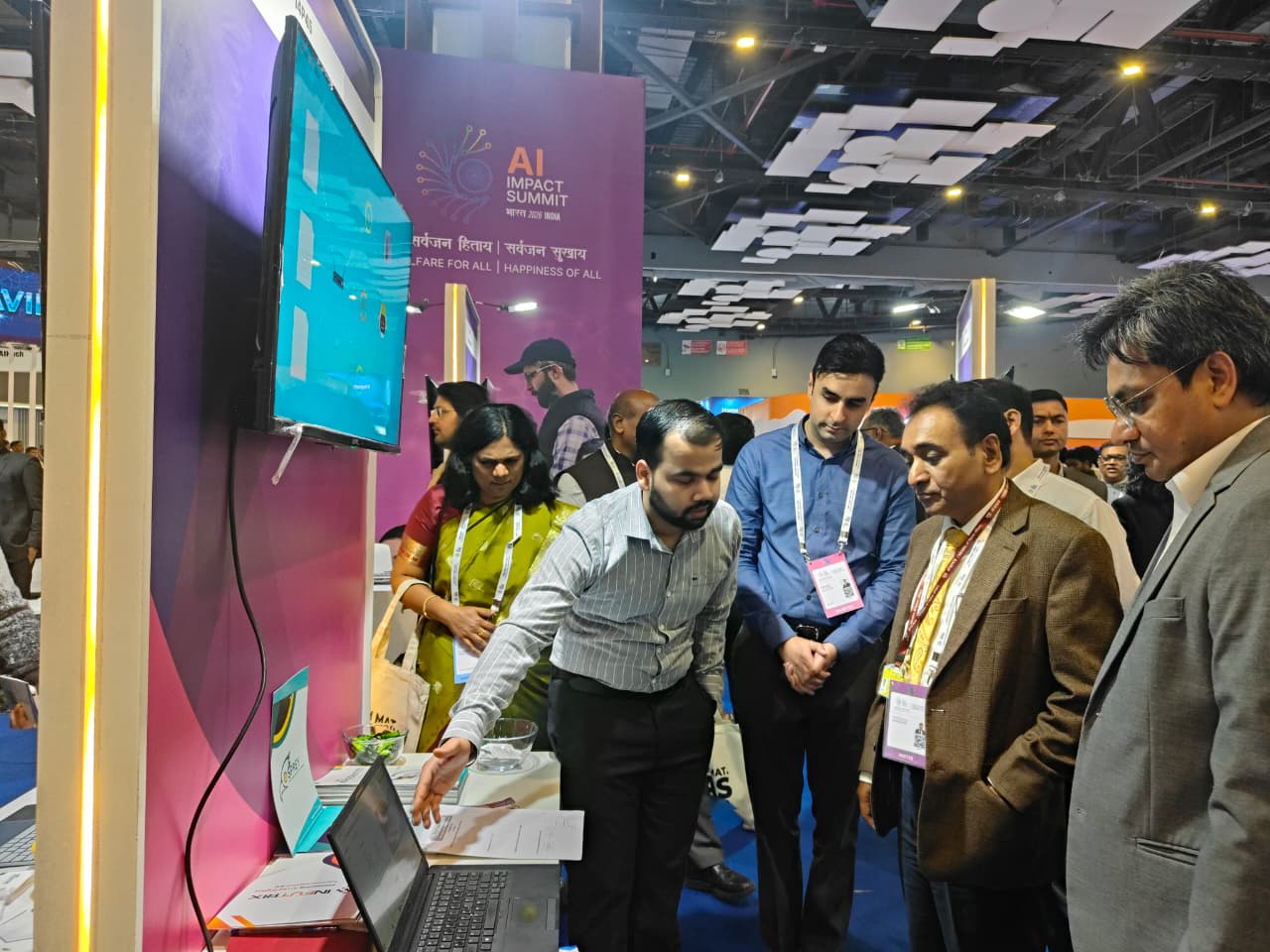
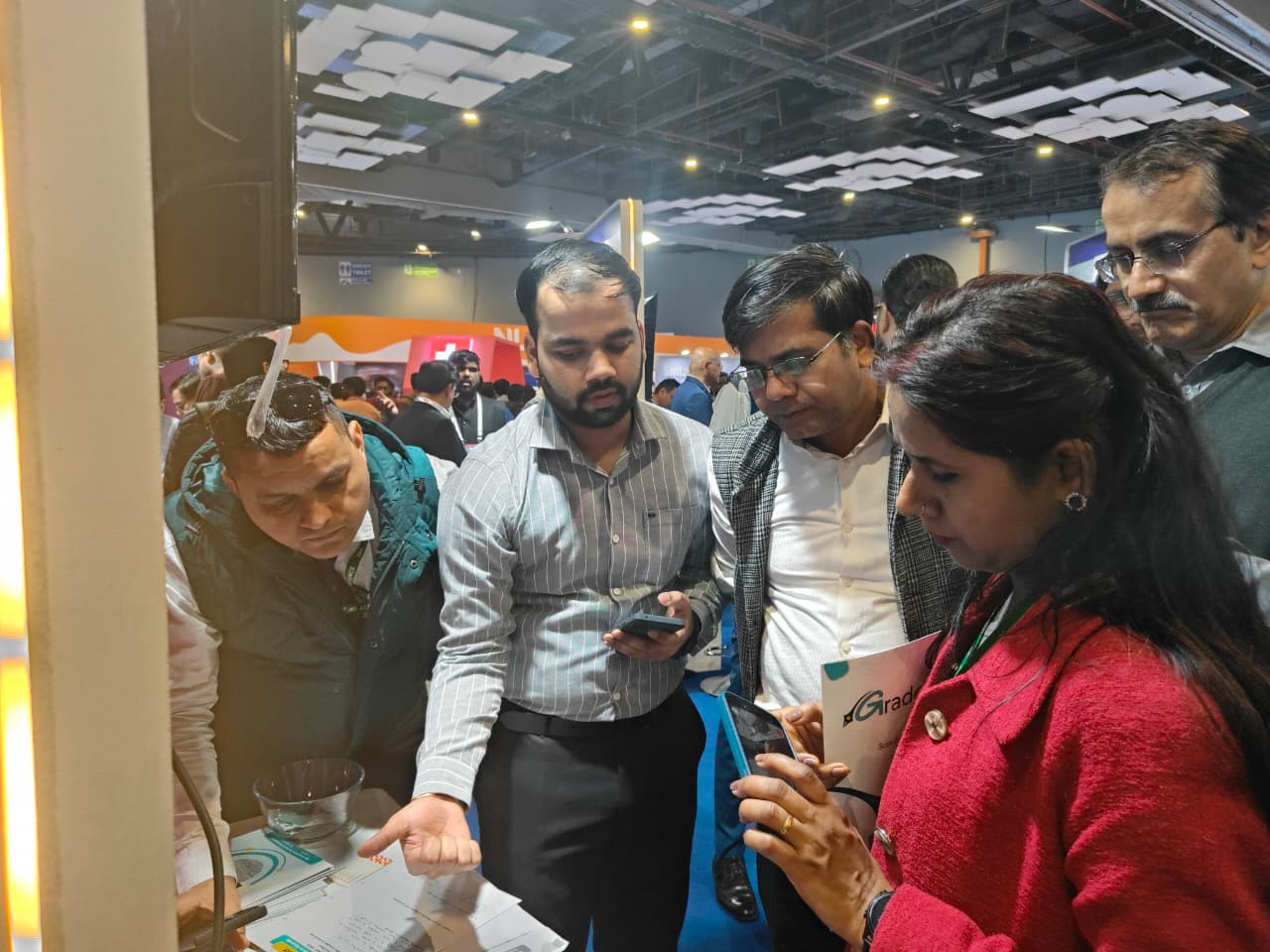
Visitors watching a GradeSmith evaluation at the Infutrix pavilion
Live evaluation walkthrough at the pavilion
Delegates reviewing a scanned answer script on the GradeSmith platform
Delegates reviewing a marked script
The Infutrix GradeSmith team at the AI Impact Summit
The GradeSmith team · Infutrix Technologies
Common questions

What institutions ask before a pilot.

Anything not covered here, ask us directly — we reply within one working day.

{{ f.a }}

Talk to our team

See it read your own scripts.

Send us a sample of your own answer scripts and your rubric. We'll evaluate them live and walk you through every mark, criterion by criterion — no setup, no commitment.

Book a Live Demo See a sample evaluation report We reply within one working day